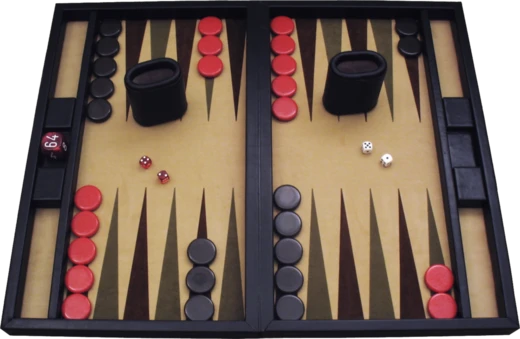
Thorp count
Mathematician who devised a backgammon endgame probability method.

Erica (Thorp) de Berry (1890-1943) · Public domain
Edward Oakley Thorp (born August 14, 1932) is an American mathematician, author, hedge fund manager, and blackjack researcher. He applied probability theory in new ways, notably using tiny statistical correlations to achieve consistent financial profits. Thorp also created the "Thorp count," a system for estimating win probability in specific backgammon endgames.
Thorp grew up in Chicago before moving to southern California as a child. He showed an early talent for science, building his own experiments, and became one of the youngest licensed amateur radio operators at age 12. He earned scholarships by winning chemistry and physics competitions—one win even led to a meeting with President Truman. He started at UC Berkeley but transferred to UCLA after a year to major in physics, later earning a PhD in mathematics there in 1958. He met his wife Vivian during his first year at UCLA; they married in January 1956.
For his blackjack research, Thorp used an IBM 704 computer, learning Fortran to program probability equations based on the Kelly criterion from a 1956 paper. He analyzed blackjack extensively, devising card-counting schemes that improved his odds, especially near the end of a deck not reshuffled after each hand. He tested these theories in Reno, Lake Tahoe, and Las Vegas with $10,000 in venture capital from professional gambler Manny Kimmel. After winning $11,000 in a single weekend, his methods were confirmed. Casinos responded by shuffling decks much earlier. Thorp often wore disguises like wraparound glasses and false beards during his Las Vegas trips. He also assembled a baccarat team that won consistently.
News of his success spread quickly, making Thorp a celebrity among blackjack players. He published *Beat the Dealer* in 1962 (updated in 1966), widely seen as the first card-counting guide. It sold over 700,000 copies, landed on the *New York Times* bestseller list, and thinly disguised Kimmel as "Mr. X." Thorp considered the whole project an academic exercise, and his research reached the public without going through standard peer review. While a professor at MIT, he met Claude Shannon and took Shannon and his wife Betty as partners on weekend gambling trips to Las Vegas, where Thorp excelled at blackjack and roulette. Their roulette system used the first wearable computer in a casino, co-developed with Shannon between 1960 and 1961. One ope
- born
- August 14, 1932
- field
- Mathematics, finance, gambling research
- nationality
- American
- known_for
- Beat the Dealer, card counting, wearable computer, hedge fund techniques, Thorp count in backgammon
Lore & Background
Thorp received his Ph.D. in mathematics from UCLA in 1958 and worked at MIT from 1959 to 1961. He was a professor of mathematics at New Mexico State University from 1961 to 1965, then at the University of California, Irvine from 1965 to 1982. He used the IBM 704 computer to analyze blackjack probabilities, leading to his book Beat the Dealer (1962), which proved card counting could overcome the house advantage. He also collaborated with Claude Shannon to create the first wearable computer for roulette prediction.
Reader's Guide
The Thorp count is a specific method developed by Edward O. Thorp for calculating the likelihood of winning in certain endgame positions in backgammon. While Thorp is best known for his blackjack card counting and hedge fund strategies, this backgammon contribution reflects his broader application of probability theory to games of skill and chance. The method is part of his legacy as a mathematician who systematically analyzed gambling and financial markets using mathematical models. His work in backgammon, though less famous than his blackjack research, demonstrates the same analytical approach that characterized his career. Thorp's contributions to backgammon are noted alongside his other achievements, including his membership in the Blackjack Hall of Fame and his pioneering use of computers for gaming analysis.
Did You Know?
- Thorp devised the 'Thorp count' for calculating winning likelihood in certain backgammon endgame positions.
- He collaborated with Claude Shannon to create the first wearable computer, tested in June 1961.
- His book Beat the Dealer sold over 700,000 copies and made the New York Times bestseller list.
- Thorp was an inaugural member of the Blackjack Hall of Fame.
The Mathematics of Beating the House
Edward O. Thorp's foray into blackjack was not a casual gambling habit but a rigorous mathematical investigation. Drawing on the Kelly criterion from a 1956 paper, he learned Fortran specifically to program probability equations and ran his models on the IBM 704 mainframe. His central insight was that as a shoe of cards progressed without reshuffling, the composition of remaining cards created exploitable statistical edges. To validate his theory beyond the screen, Thorp traveled to Reno, Lake Tahoe, and Las Vegas with $10,000 in venture capital supplied by professional gambler Manny Kimmel. The results were immediate: he banked $11,000 in a single weekend at Reno tables. Casinos responded by shuffling earlier, and Thorp resorted to disguises—wraparound glasses, false beards—during his Vegas runs. The demand for his findings was so intense that he published Beat the Dealer in 1962, a guide that sold over 700,000 copies and landed on the New York Times bestseller list. Remarkably, this body of research reached the public entirely outside the academic peer-review process, a path Thorp himself framed as an academic exercise.
The Wearable Computer and the Shannon Partnership
While serving as a mathematics professor at MIT between 1959 and 1961, Thorp crossed paths with the legendary information theorist Claude Shannon. Their collaboration produced what is widely regarded as the first wearable computer, co-developed over 1960 and 1961. The device was designed for a very specific purpose: gaining an edge at the roulette wheel. In operation, one team member watched the spinning wheel and tapped the cadence with his toe into a small input mechanism, while a second member received calculated betting suggestions as musical tones through a concealed earpiece. Rather than targeting a single number, the system directed bets toward clusters of neighboring numbers, generating a statistical advantage sufficient for profit. The final working version was tested in Shannon's basement laboratory in June 1961. Thorp, Shannon, and Betty Shannon played roulette and blackjack together on weekend excursions to Las Vegas, with Thorp's blackjack team also turning a profit. The success of these devices eventually prompted the Nevada legislature to pass an emergency devices law on May 30, 1985, criminalizing such technology in casinos. For his broader contributions, Thorp was inducted as an inaugural member of the Blackjack Hall of Fame.
From Probability Theory to Hedge Fund Success
Thorp's mastery of probability and statistics did not stop at casino tables. Beginning in the late 1960s, he turned his analytical lens toward securities markets, identifying and exploiting pricing anomalies that most investors overlooked. His first venture, Princeton/Newport Partners, operated from 1969 to 1989 and was built around market-neutral derivatives hedging. After a gap, he launched Ridgeline Partners in August 1994, which pursued statistical arbitrage strategies until its closure in September 2002, largely because those strategies had been generating modest returns since the turn of the decade. By May 1998, Thorp reported that his personal investment portfolio had delivered an annualized return of 20 percent, averaged over 28.5 years—a remarkable figure for a private investor. He authored numerous articles on option pricing, the Kelly criterion, statistical arbitrage in a six-part series, and the concept of inefficient markets. He also demonstrated early and prescient skepticism toward Bernie Madoff's implausibly high reported returns, a stance that proved vindicated. Today he serves as President of Edward O. Thorp & Associates, headquartered in Newport Beach, California.
A Life Built on Curiosity and Rigor
Born Edward Oakley Thorp on August 14, 1932, in Chicago, the young Thorp relocated to southern California during his childhood, where his restless scientific curiosity found fertile ground. He tinkered with self-designed experiments and, at just twelve years old, earned certification as one of the youngest amateur radio operators. His academic excellence in chemistry and physics competitions earned him scholarships, and on one occasion his achievements brought him face to face with President Truman. He initially enrolled at UC Berkeley for his undergraduate studies but transferred after a single year to UCLA, where he majored in physics and eventually completed a Ph.D. in mathematics in 1958. It was during his first year at UCLA that he met Vivian, whom he married in January 1956. His academic career took him through a series of institutions: a two-year stint at MIT (1959–1961), a professorship at New Mexico State University (1961–1965), and a long tenure at the University of California, Irvine, where he held a mathematics chair from 1965 to 1977 before expanding his title to include finance through 1982. This trajectory—from radio operator to doctorate to multi-institution professor—laid the intellectual groundwork for everything that followed.
Gallery
Frequently Asked Questions
What is the Thorp count in backgammon?
The Thorp count is a probability-based method for calculating a player's chance of winning from a specific backgammon endgame position. Instead of relying on gut feeling, it breaks the position down into discrete dice-roll scenarios and assigns a concrete win percentage.
Who created the Thorp count?
Edward O. Thorp, the American mathematician famous for his blackjack card-counting work, devised the system. He extended his statistical-probability toolkit from casino games into backgammon endgame analysis.
How does the Thorp count actually work?
You enumerate every possible dice outcome from the given board position and tag each one as a win or a loss. Summing those weighted outcomes yields a single percentage that tells you exactly how favorable the position is.
What kinds of positions does the Thorp count apply to?
It is built for finite, well-defined endgame situations where the number of remaining dice rolls is small enough to enumerate. It is not a general mid-game strategy but a focused tool for particular board configurations near the finish.
Why do backgammon fans consider the Thorp count significant?
It was one of the first rigorous, numbers-driven approaches to evaluating backgammon endgames, shifting the conversation from intuition to measurable odds. Its existence showed that the same probability thinking used in casino research could sharpen play at the backgammon table.
More in Backgammon 1-18
Spotted an error? Know more?
This is a living reference — every entry is fact-audited, and reader corrections feed straight into our audit queue. Suggest an edit · See this site's audit record