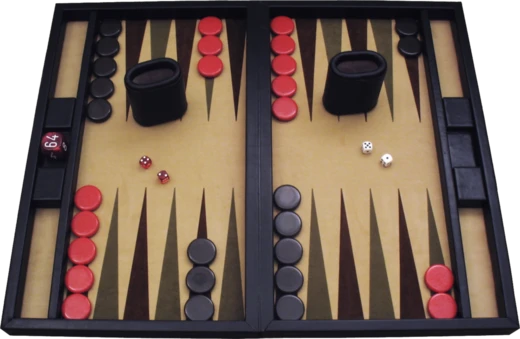
TD-Gammon
Early neural-network program that advanced backgammon theory through self-play.

TD-Gammon is a backgammon-playing computer program created by Gerald Tesauro at IBM's Thomas J. Watson Research Center during the 1990s. The program's name comes from its core technique: training an artificial neural network using temporal-difference learning, specifically TD-Lambda. By exploring strategies that human players had not previously considered, it helped advance the understanding of optimal backgammon play.
After training through 1.5 million games of self-play, version 2.1 of TD-Gammon (from 1993) reached a skill level just below that of the top human players of the era. In a 100-point match held in 1998, the world champion defeated it by only 8 points. Some of TD-Gammon's unconventional evaluations of opening moves were later accepted and adopted by expert players. The program is frequently noted as an early milestone in reinforcement learning and neural networks, and it was cited in research papers on deep Q-learning and AlphaGo.
**Algorithm for play and learning**
During a game, TD-Gammon examines every legal move and all possible responses to each move (a lookahead search). It feeds each resulting board position into its evaluation function and selects the move that yields the highest score. In this respect, it is similar to most other computer board-game programs. What set TD-Gammon apart was how it learned that evaluation function.
The learning algorithm updates the weights in its neural network after each turn. It reduces the difference between the network's evaluation of the board position from the previous turn and its evaluation of the current turn's position—hence the term "temporal-difference learning." The evaluation for any board position consists of four numbers, representing the program's estimate of the likelihood of each possible game outcome: White wins normally, Black wins normally, White wins a gammon, or Black wins a gammon. Backgammon wins are implicitly represented as the complement of these four probabilities. For the final board position of a game, the algorithm compares its evaluation with the actual result rather than with its own evaluation of that position.
The core of TD-Gammon is a three-layer neural network.
The input layer contains two types of neurons. One type encodes the board position using non-negative integers from 0 to 15, indicating the number of White or Black checkers at each location. There are 9
- field
- Artificial intelligence, reinforcement learning, neural networks
- known_for
- Early success of temporal-difference learning and neural networks in game-playing; influencing backgammon theory
- developer
- Gerald Tesauro
- institution
- IBM's Thomas J. Watson Research Center
- year_introduced
- 1990s
Lore & Background
TD-Gammon was initially programmed 'knowledge-free,' using only a raw board encoding with no human-designed features. In early experiments, it reached a level comparable to Neurogammon, an intermediate-level human player. Tesauro then added hand-crafted features previously used in Neurogammon, such as 'advanced anchor' and 'blockade strength,' and the self-training program soon surpassed all previous computer backgammon programs. It stopped improving after about 1,500,000 games of self-play using a three-layered neural network with 198 input units, 80 hidden units, and one output unit.
During play, TD-Gammon examined all possible legal moves and their responses (lookahead search), feeding each resulting board position into its evaluation function. Its learning algorithm updated neural network weights after each turn to reduce the difference between evaluations of previous and current board positions—temporal-difference learning. The output layer had four neurons representing probabilities of White normal win, White gammon win, Black normal win, and Black gammon win. Backgammon wins were not represented.
TD-Gammon explored strategies that humans had not pursued, leading to advances in backgammon theory. For example, on opening plays with rolls of 2-1, 4-1, or 5-1, it found that splitting 24-23 was superior to the conventional 'slotting' move. Tournament players adopted this, and slotting disappeared from tournament play for several years. Backgammon expert Kit Woolsey found TD-Gammon's positional judgment superior to any human's.
Reader's Guide
TD-Gammon's significance lies in its demonstration that a neural network trained solely through self-play and temporal-difference learning could achieve a level of play just below that of top human backgammon players. In 1993, version 2.1 trained with 1.5 million games of self-play reached that level. In 1998, during a 100-game series, it was defeated by the world champion by a mere 8 points. Its unconventional assessments of opening strategies were accepted and adopted by expert players.
The program's legacy extends beyond backgammon. It is commonly cited as an early success of reinforcement learning and neural networks, and was referenced in papers for deep Q-learning and AlphaGo. TD-Gammon was never commercialized or released to the public, but it inspired commercial neural-network-based backgammon programs such as JellyFish (1994) and Snowie (1998). Its strengths and weaknesses were the opposite of symbolic AI programs: it excelled at intuitive positional play but was poor at endgame analysis and doubling strategies, the latter due to the neural network being trained without the doubling cube.
Did You Know?
- TD-Gammon's name comes from its use of temporal-difference learning (TD-Lambda) to train an artificial neural network.
- In 1998, during a 100-game series, TD-Gammon was defeated by the world champion by a mere margin of 8 points, mainly due to one doubling blunder that cost -32 points.
- TD-Gammon was initially programmed 'knowledge-free' and reached a level comparable to Neurogammon, an intermediate-level human player, before hand-crafted features were added.
- After 1992, TD-Gammon was trained with λ=0, degenerating into standard TD-learning, which saved compute by a factor of 2.
The Road to Mastery: Training and Version Evolution
TD-Gammon's journey from a simple 1-ply search in version 1.0 to the sophisticated 3-ply search of version 3.1 represents a remarkable arc of iterative improvement. The earliest iteration simply scored every legal next move with its neural network and selected the highest-scoring option. Versions 2.0 and 2.1 introduced a two-stage process: first pruning unlikely moves, then running a minimax analysis weighted across the 21 possible dice rolls, with non-doubles counted twice as heavily as doubles. Versions 3.0 and 3.1 expanded this to 441 possible dice combinations. The training itself was a feat of computational patience—version 2.1 required 1.5 million games of self-play to reach a level just shy of the world's best human players. Tesauro observed that the program stopped improving after roughly that many games when using a three-layer network with 198 input units, 80 hidden units, and a single output unit. The final version, 3.1, was specifically tuned for a high-stakes exhibition match, showing that even at its peak the program remained a work in progress shaped by a particular opponent.
Inside the Brain: Architecture and Temporal-Difference Learning
At its core, TD-Gammon is a three-layer neural network whose input layer carries 198 neurons—99 per color—encoding the raw board position as non-negative integers from 0 to 15 indicating checker counts at each location, plus additional hand-crafted features inherited from the earlier Neurogammon program, such as anchor strength, blockade quality, home-board strength, and the probability of a blot being hit. The hidden layer, which grew in size across later versions, processes these signals before passing them to four output neurons that estimate the probability of each possible game outcome: a normal win or gammon win for either White or Black. Backgammon wins, being exceedingly rare, were deliberately excluded from the model. What made TD-Gammon revolutionary was not its search during play—standard lookahead and evaluation—but how it learned. After every turn, the network adjusted its weights to close the gap between its own evaluation of the previous position and the current one, a process called temporal-difference learning. Tesauro discovered that a small lambda value performed nearly as well as a large one, so after 1992 he set lambda to zero, reducing the method to plain TD-learning and halving the computational cost.
Testing the Machine: Competitive Encounters
TD-Gammon's competitive record reads like a slow-motion collision between silicon and human intuition. In 1993, version 2.1, fresh from 1.5 million self-play games, reached a standard just below the top human players of the era. By 1998, the gap had narrowed to the point where a 100-game series against the reigning world champion ended with the human winning by only 8 points—a margin so thin it underscored how close the machine had come. The most dramatic showcase came at the 1998 AAAI Hall of Champions, where version 3.1 faced Malcolm Davis in a specially prepared exhibition. The program lost by 8 points, a result Tesauro attributed largely to a single catastrophic blunder: TD-Gammon chose to double and was gammoned for a 32-point swing. That one decision, a misjudgment of the doubling cube, erased what had otherwise been an extraordinarily close contest. These matches mattered not because the machine won, but because they demonstrated that a neural network trained purely through self-play could rival the deepest strategic instincts of a world-class backgammon player, all without being explicitly taught what good play looked like.
Reshaping a Game and a Field: Legacy and Influence
TD-Gammon's influence radiated far beyond the backgammon table. In the backgammon community, its unconventional assessments of certain opening strategies were so persuasive that expert players began adopting them, effectively shifting what was considered theoretically correct play. The program proved that a knowledge-free system, discovering its own evaluation criteria through millions of self-play games, could uncover insights that human experts had never articulated. In the broader AI landscape, TD-Gammon is routinely cited as one of the landmark early successes of reinforcement learning combined with neural networks. Its name appears in the literature of deep Q-learning and in the foundational papers behind AlphaGo, serving as a proof-of-concept that temporal-difference methods could drive a neural network to near-human performance in a complex, stochastic game. For Gerald Tesauro and IBM's Thomas J. Watson Research Center, the project demonstrated that the marriage of temporal-difference learning and artificial neural nets was not merely a theoretical curiosity but a practical engine for discovery, capable of generating new strategic knowledge in a domain long thought to require human intuition.
Frequently Asked Questions
What is TD-Gammon?
TD-Gammon is a backgammon-playing computer program built in the 1990s by Gerald Tesauro at IBM's Thomas J. Watson Research Center. It gained recognition as one of the earliest successful applications of neural networks combined with reinforcement learning in a board-game setting.
How does TD-Gammon learn to play backgammon?
Instead of encoding human heuristics, TD-Gammon improves by playing millions of games against itself and updating its neural network through temporal-difference learning (specifically TD-Lambda). This self-play loop let it uncover positional strategies that human players had never seriously explored.
How did TD-Gammon stack up against top human players?
After roughly 1.5 million self-play games, version 2.1 (1993) performed at a level just below the era's strongest human competitors. It was competitive with elite players but had not yet fully matched the very best.
Who created TD-Gammon and where was it developed?
Gerald Tesauro developed the program while at IBM's Thomas J. Watson Research Center during the 1990s. The project became a landmark proof that temporal-difference reinforcement learning could handle a stochastic game as complex as backgammon.
Why is TD-Gammon significant to backgammon theory and AI research?
By discovering lines of play outside the range humans typically considered, TD-Gammon expanded the community's understanding of optimal backgammon strategy. It also demonstrated that a neural network trained purely through self-play could reach near-elite skill, a result that influenced later breakthroughs in artificial intelligence.
More in Backgammon 1-18
Spotted an error? Know more?
This is a living reference — every entry is fact-audited, and reader corrections feed straight into our audit queue. Suggest an edit · See this site's audit record