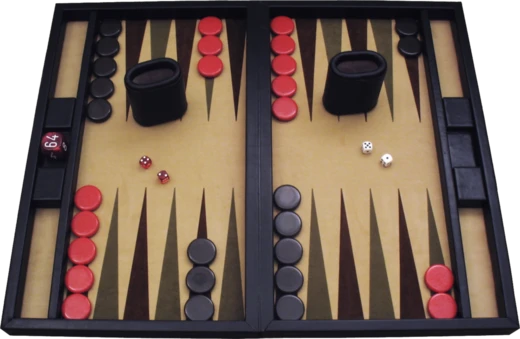
Backgammon match strategy
Match play alters doubling and checker strategy near the winning score.

Backgammon match strategy refers to the distinct approaches and tactical considerations that arise when playing backgammon in a match format, where games are played to a set number of points, as opposed to money play. These strategies become most pronounced when a player is within a few points of winning the match, influencing doubling decisions, checker play, and overall risk assessment.
- Doubling cube
- Used with centered start at 1; player may double, opponent takes or drops.
- Gammon go
- Term for trailing player at 1-away, 2-away Crawford; aggressive gammon pursuit, also known as 'gammon save'.
Lore & Background
In backgammon match play, the doubling cube is used similarly to money play, but the match score introduces unique strategic considerations. The Crawford rule, named after John R. Crawford, prevents the use of the doubling cube when a player first reaches one point short of winning, balancing the advantage for the leader. After the Crawford game, normal doubling resumes. Scores are normalized to points away from victory, such as '2 away, 3 away' for a 5-point match.
Reader's Guide
Match-specific doubling strategies are critical near the end of a match. At double match point (DMP), where the match hinges on a single game, gammons and cube actions are irrelevant, and blitz strategies become poor while back games become more attractive. At 2-away, 2-away, competent players typically double early, turning the game into DMP, with a take threshold of 30% winning chances. At 1-away, 2-away Crawford, the trailing player has about 30% match-winning odds, playing aggressively for a gammon ('gammon go'), while the leader aims to avoid gammon loss ('gammon save'). In the post-Crawford game, the trailer doubles early to create DMP, and the leader may use a 'free drop' to reset the match at 1-away, 1-away if at a disadvantage. These strategies highlight how match score overrides standard money play doubling windows.
Did You Know?
- The Crawford rule is named after John R. Crawford and is routinely used in tournament match play.
- At double match point, a blitz strategy becomes poor because gammons do not matter.
- At 2-away, 2-away, the take threshold for both players is 50% because it is double match point.
- In a post-Crawford game at 1-away, 2-away, the leader has the option of a 'free drop'.
The Doubling Cube in Match Context
The doubling cube operates in match play much as it does in individual games, yet its implications shift dramatically when a player is closing in on a target score. At the outset of every game, the cube sits on the bar showing 64, meaning it is centered on 1. The player about to roll can propose doubling the stakes, and the opponent must either accept or immediately resign the game at the current cube value. Once a double is accepted, ownership transfers to the accepting player, who alone holds the right to redouble. There is no theoretical cap on redoubles, though in practice games rarely exceed 4 points on the cube, and once the cube value becomes large enough that further re-cubes cannot alter the match outcome, it is considered dead. When a game runs to completion, the cube value is multiplied by 2 for a gammon and by 3 for a backgammon, meaning a single lost game at cube 2 can cost a player 4 or 6 points depending on the margin of defeat.
The Crawford Rule and Match Equity
Named after John R. Crawford, this rule addresses a fundamental imbalance that emerges when one player stands one point from victory. In that position, the trailing player faces a binary choice: win the next game or lose the match, regardless of whether the game is worth one point or two. This creates an overwhelming incentive to double as early as possible, since the stakes are effectively the same whether the cube is at 1 or 2. To restore fairness, the Crawford rule stipulates that the moment a player first reaches one point short of the target, the doubling cube is removed from play for the very next game, known as the Crawford game. After that game concludes, normal cube usage resumes. The rule is standard in tournament match play and is designed to protect the leader from being forced into a high-stakes single game. Notably, a Crawford game is not guaranteed to occur in every match; depending on how the score develops, the match may end before that critical threshold is reached.
The Doubling Window and Market Pressure
When both players are several points from the target, doubling decisions follow logic similar to money play, yet the match context adds layers of complexity. The theoretical take point sits at 25% winning chances: if a player faced the same double four times and dropped all four, the net loss would be 4 points, identical to accepting and losing three of four games at cube 2. In practice, a player can accept at slightly worse than 25% odds because owning the cube grants the exclusive right to redouble. Conversely, a player needs roughly 70% winning chances before offering a double becomes correct, creating a doubling window of approximately 70% to 78% where both the double and the take are theoretically justified. Players aim to double at the top of the market, as close as possible to the opponent's take point. If the opponent correctly drops, the doubler has lost his market; if the opponent correctly takes, the doubler has kept his market. A sudden dice roll, sometimes called a joker, can radically shift the position and turn a previously correct double into a drop.
Double Match Point and Strategic Shifts
Double match point describes any situation where the match hinges entirely on the outcome of a single game, rendering gammons, backgammons, and cube actions irrelevant to the final result. This occurs at scores like 1-away, 1-away, or in a post-Crawford game at 1-away, 2-away where the leader accepts an early double, or in a doubled game at 2-away, 2-away. Because the margin of victory no longer matters, the strategic calculus shifts dramatically. A blitz, in which a player aggressively hits in his own board to pursue a gammon at the risk of overextending, becomes a poor choice since the extra point is worthless. Conversely, back games, where a player maintains two or more anchors in the opponent's home board with the intention of hitting later, become a more attractive option because only one point is needed. In practice, however, double match point games are most frequently decided by a straightforward racing strategy when one player has the opportunity to bring all checkers home first.
Frequently Asked Questions
What is backgammon match strategy?
It refers to the tactical adjustments a player makes when competing toward a target score (match play) instead of playing for a fixed stake (money play). These adjustments sharpen dramatically once a player is within a few points of winning, reshaping how they handle the doubling cube, checker positioning, and overall risk.
How does match strategy change doubling cube decisions?
Because the cube starts centered at 1 and each side can double or drop, the score context makes a single double worth more or less than it would in money play. A player sitting 1-away may double to force the opponent into a high-risk take, while the trailing side must weigh whether dropping saves the match or accepting it does.
What does 'gammon go' mean in backgammon match strategy?
It is the aggressive, all-out posture a trailing player adopts when sitting 1-away or 2-away in a Crawford game, pushing hard to win by gammon and leapfrog the opponent. Fans also call it a 'gammon save' because the trailing player is essentially trying to rescue the match with a double-point victory.
How does match-point strategy differ from regular money play?
In money play every game carries the same financial weight, so optimal decisions stay relatively uniform. In match play, being 1-away or 2-away near the target score fundamentally changes which positions to take, which doubles to offer, and whether to chase a gammon or simply avoid losing the point.
Why is match strategy important in competitive backgammon?
Most high-stakes tournaments are decided in match format, so mastering score-dependent tactics is what separates strong players from champions. Misreading the match point can cost a player a title—whether by offering a double that should have been dropped or by failing to press for a gammon when the score demands it.
More in Backgammon 1-18
Spotted an error? Know more?
This is a living reference — every entry is fact-audited, and reader corrections feed straight into our audit queue. Suggest an edit · See this site's audit record