Backgammon notation
A system for recording backgammon games developed by Paul Magriel.

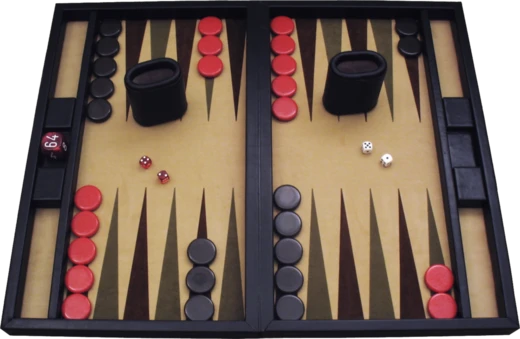
Backgammon notation, created by Paul Magriel in the 1970s, is a method for recording games. It describes checker movements by numbering the board’s points from 24 down to 1, as seen from Black’s perspective in the standard diagram. From Black’s view, the numbers decrease as her checkers move counterclockwise toward her home board in the bottom right. When White is to move, the numbering reverses: what was the 24-point becomes the 1-point, and so on.
Dice rolls are written as either “4-2” or “42,” meaning a four on one die and a two on the other. Moves are recorded with the roll followed by the point numbers, like “4-2: 8/4 6/4,” which indicates moving a checker from point 8 to 4 and another from 6 to 4. If a move hits an opposing checker, an asterisk is added to the destination point—for example, “13/7*” means a checker moves from the 13-point and hits at the 7-point. A move that hits mid-step is shown as “13/7*/5,” representing a 6-2 roll where the checker goes from 13 to 5 and hits at point 7.
For double rolls, the number of checkers moved is often placed in parentheses after the move. For instance, a roll of 2-2 might be recorded as “6/4(3) 13/11,” meaning three checkers move from 6 to 4 and one from 13 to 11. Finally, the words “bar” and “off” are used for entering a checker from the bar or bearing off, as in “bar/22 17/9” or “5/off 2/off.”
- field
- Backgammon notation
- developed_by
- Paul Magriel
- era
- 1970s
- purpose
- Recording backgammon games
Lore & Background
Backgammon notation involves numbering the points around the board from 24 to 1, as seen from black's perspective, with checkers moving counterclockwise toward the home board. The numbering reverses when white is on roll, so the 24-point becomes the 1-point. Dice rolls are written as '4-2' or '42', and moves are recorded by indicating the starting and ending points, such as '8/4 6/4'.
Reader's Guide
The notation includes special symbols: an asterisk (*) denotes a hit, as in '13/7*', and a double slash indicates a hit at an intermediate point, e.g., '13/7*/5'. For double rolls, the number of checkers moved is placed in parentheses, like '6/4(3) 13/11'. The words 'bar' and 'off' are used for entering from the bar or bearing off, as in 'bar/22' or '5/off'. This system allows precise recording of moves and board states, as illustrated in accompanying figures.
Did You Know?
- Backgammon notation was developed by Paul Magriel in the 1970s.
- Points are numbered from 24 to 1 from black's perspective, reversing for white.
- An asterisk after a point number indicates a hit, e.g., 13/7*.
- The words 'bar' and 'off' are used for entering from the bar or bearing off.
Core Mechanics & The Namesake Win
Backgammon is a two-player race in which each side commands 15 pieces—traditionally called "men" (short for tablemen), though in the United States the term "checkers" has gained ground in recent decades. These pieces travel along 24 points on a board, their movement dictated entirely by the roll of two dice. The goal is straightforward in concept: move all fifteen pieces around the board and bear them off before your opponent does. Yet the game's namesake comes from a specific outcome—when one player achieves this while the opponent remains far behind, the result is a triple win called a "backgammon." The interplay of strategy and chance defines the experience. A single roll can swing a game, but over a long series, the sharper player's record will prevail. Each dice roll opens multiple possible moves, and skilled players must anticipate how their opponent might respond. The optional doubling cube adds another layer, letting players raise the stakes mid-game.
Ancient Roots & the Long Lineage
Backgammon is a relatively young member of a vast family of tables games stretching back nearly five millennia. The oldest known game set, unearthed from the Jiroft culture in Iran, features a dumbbell-shaped board with counters and dice, though its exact rules remain unclear. The Royal Game of Ur, dating to 2600 BC, stands as the oldest game with surviving rules and may serve as an ancestor or intermediate step. In the Sasanian Empire, the Persian game nard emerged between the 3rd and 6th centuries AD, with one text crediting its invention to Ardashir I and another to the vizier Bozorgmehr Bokhtagan under Khosrow. The Roman ludus duodecim scriptorum, mentioned as early as Ovid's Ars Amatoria (1 BC to 8 AD), used three rows of 12 points and three dice. Its direct descendant, Tabula, described in an epigram of Byzantine Emperor Zeno (AD 476–491), already featured the familiar 24-point layout with 15 counters per player, though it used three dice and lacked a bar or doubling die.
Medieval Spread & Artistic Legacy
Tables games first took root in France during the 11th century, quickly becoming a favorite pastime among gamblers. Their popularity was so pronounced that in 1254, Louis IX issued a decree banning his court officials and subjects from playing. The games spread steadily across the continent: appearing in Germany by the 12th century, reaching Iceland by the 13th, and spreading to Sweden by the 17th century. In Spain, the 1283 manuscript Libro de los Juegos, completed under Alfonso X, documented rules for various dice and table games alongside chess. The Vasa shipwreck yielded a wooden board and counters among the officers' belongings, confirming the game's presence on Swedish waters. Artistic depictions flourished, with Dutch and German painters like van Ostade, Jan Steen, Hieronymus Bosch, and Bruegel frequently capturing players at tables. Caravaggio's Cardsharps remains one of the most celebrated surviving works from this era.
From Irish to the Modern Game
Backgammon's immediate ancestor was the 16th-century Anglo-Scottish tables game known as Irish, the British counterpart to the French Toutes Tables and Spanish Todas Tablas—the latter name first appearing in the 1283 Libro de los Juegos, a translation of Arabic manuscripts by the Toledo School of Translators. Irish enjoyed particular favor at the Scottish court of James IV and was regarded as "the more serious and solid game" compared to the simpler variant that would eventually take the name Backgammon. The earliest specific written reference to backgammon itself appears in a 1647 letter, marking its emergence as a distinct game in the first half of the 17th century. By the 19th century, backgammon had expanded across Europe, where it rapidly outpaced rivals like Trictrac in popularity, and reached America, where the doubling cube was introduced. In other regions, different tables games such as Nard or Nardy remained the more familiar pastimes.
Frequently Asked Questions
Who developed Backgammon notation and when?
Paul Magriel created the system in the 1970s as a standardized way to write down backgammon games. Before his work, players had no consistent shorthand for capturing moves on paper.
What exactly is Backgammon notation used for?
It is a recording method that lets players transcribe the full sequence of a backgammon match move by move. Tournaments, study groups, and online archives all rely on it to preserve and share games.
How does the point-numbering in Backgammon notation work?
Points are numbered 24 down to 1 from Black's perspective, decreasing counterclockwise toward her home board in the bottom-right corner. When it is White's turn, the numbering flips so that what was the 24-point becomes the 1-point for her checkers.
How do you write a dice roll and the resulting move in Backgammon notation?
A roll is expressed as two digits, either with a hyphen like 4-2 or simply 42, indicating the values on each die. The move is then written immediately after the roll, specifying which point a checker leaves and which point it lands on.
Why is Backgammon notation considered important to the backgammon community?
It gave the game a universal written language, making it possible to publish analyses, teach positions, and keep records of professional matches. Without it, detailed review of a game would rely on memory or clunky descriptive prose.
More in Backgammon 1-18
Spotted an error? Know more?
This is a living reference — every entry is fact-audited, and reader corrections feed straight into our audit queue. Suggest an edit · See this site's audit record