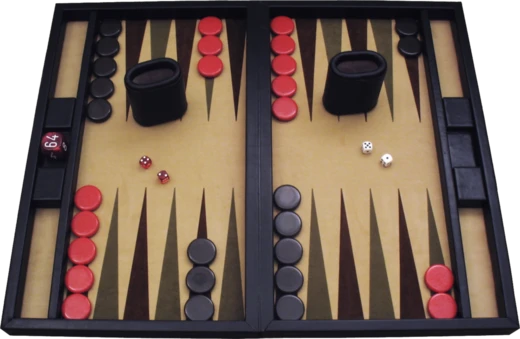
Backgammon chouette
Multiplayer backgammon variant with team play and rotating box.

Takuro Iwabuchi from Takarazuka, JAPAN · CC BY 2.0
Backgammon chouette is a variant for three or more players. Originally played face-to-face, it is now also played online across different countries on various platforms. The game is fast, with frequent doubling cube use, lively discussion and disputes over moves, and shifting alliances among players.
In a chouette, one player, called the box, competes against a team made up of everyone else. The team has a captain, and the box and playing order are usually set by dice rolls. Play follows standard backgammon rules on a single board. The captain makes the final call on checker moves, though teammates can offer advice. Each team member typically has their own doubling cube against the box, and can double, accept, or refuse independently of the others. This means that, while using one board, each team member is effectively playing a separate game against the box.
Chouette is played like money play, not a match. There is no match score; one game is played, points are tallied, and a new game starts. Player positions rotate after each game. If the box wins, they stay the box. If the captain wins, they become the box for the next round. The loser goes to the bottom of the order, and everyone else moves up one spot. In one variation, team members who correctly accepted or declined a double move ahead of those who chose wrong. Each player keeps a running score of points won or lost per game, adjusted for gammons, backgammons, and the doubling cube’s value.
- field
- Board game variant
- known_for
- Multiplayer backgammon with a box versus a team, separate doubling cubes, and rotating positions
Lore & Background
In a chouette, one player—the box—plays against a team consisting of all other participants. One member of the team is designated as the captain. The box and the rotation order are generally determined by the roll of dice. The game is played on a single backgammon board according to standard rules, with the captain making the final decision on all checker plays for the team, although help from teammates can be requested in some situations.
All members of the team have their own doubling cube versus the box, and can double regardless of what other teammates do, and they can accept or refuse a double independently of the other players. The result is that, although they are using a single backgammon set, each member on the team is playing a separate game against the box.
A chouette is generally played in the same way as backgammon money play. There is no match score; one game is played, scores are tabulated, and another game begins. The positions of the players are rotated after each game. If the box wins, this player remains the box. If the captain wins, the captain becomes the box for the next round. The loser goes to the bottom of the order and all other players move up one spot. In one variation, team members who successfully accepted or declined a double progress ahead of those who made the wrong decision.
Reader's Guide
The backgammon chouette is significant as a social and strategic variant that transforms the two-player game of backgammon into a multiplayer competition. Its structure—one box versus a team with a captain—creates dynamic alliances and rivalries, while the use of separate doubling cubes for each team member adds layers of individual risk and reward. The rotation system ensures that players frequently change roles, maintaining engagement and fairness. The variant's adaptation to internet play has expanded its reach, allowing participants from different countries to compete on various platforms. Its legacy lies in preserving the core mechanics of backgammon while introducing team strategy, debate over moves, and a fast-paced, ever-shifting hierarchy. The chouette remains a popular format for both casual and serious backgammon players, emphasizing discussion, dispute, and the psychological aspects of doubling decisions.
Did You Know?
- The backgammon chouette is a variant for three or more players.
- One player, the box, plays against a team of all other participants.
- Each team member has their own doubling cube and can double independently of other teammates.
- If the box wins, that player remains the box; if the captain wins, the captain becomes the box.
A Five-Millennium Thread of Dice and Counters
Backgammon's lineage reaches back roughly five thousand years to archaeological finds from the Jiroft culture in modern-day Iran, where a dumbbell-shaped board with counters and dice was uncovered. Though its precise rules are lost, scholar Irving Finkel has proposed a reconstruction he terms the Game of 20 Squares. The Royal Game of Ur, from around 2600 BC, is the oldest tables game with surviving rules and used tetrahedral dice. Between the 10th and 7th centuries BC, further board games surfaced across Iraq, Syria, Egypt, and western Iran. In the Sasanian Empire, the Persian nard or nardšir emerged between the 3rd and 6th centuries AD, with one text attributing its creation to Ardashir I and another to the vizier Bozorgmehr Bokhtagan under Khosrow. The earliest clearly identifiable tables game, Tabula, appears in an epigram by Byzantine Emperor Zeno around AD 476–491. It already carried the familiar 24-point layout and 15 counters per player, yet used three dice, had no bar, and included no doubling die. Its Roman predecessor, ludus duodecim scriptorum, arranged three rows of twelve points and was referenced as early as Ovid's Ars Amatoria, composed between 1 BC and 8 AD.
Strategy, Luck, and the Art of the Roll
At its core, backgammon is a two-player contest of opposing movement in which each competitor commands fifteen pieces—traditionally called men, though increasingly referred to as checkers in the United States—moving them along twenty-four points according to the throw of two dice. The goal is straightforward in description: race your pieces around the board and bear them all off before your opponent does. When you achieve that while your rival is still far behind, the result is a triple victory called a backgammon, which is where the game takes its name. What elevates backgammon beyond a simple race is the interplay of strategy and chance. The dice dictate the outcome of any single match, yet over a long series of games the stronger player's record will prevail. Every roll presents a web of possible moves, and skilled players must anticipate their opponent's counter-moves. The optional doubling cube adds another layer, letting players raise the stakes mid-game when they sense the advantage shifting in their favor.
A Pastime Across European Courts and Canvas
Tables games first took hold in France during the 11th century, quickly becoming a beloved pastime among gamblers. Their popularity was such that in 1254, King Louis IX issued a decree forbidding his court officials and subjects from playing. By the 12th century the games had reached Germany, and by the 13th they were known in Iceland. In Spain, King Alfonso X's manuscript Libro de los Juegos, completed in 1283, laid out rules for several dice and table games alongside its chess discussions; the Spanish name Todas Tablas first appears in that text, a translation of Arabic manuscripts by the Toledo School of Translators. By the 17th century the games had spread to Sweden, and a wooden board with counters was even recovered from the wreck of the Vasa among the personal effects of the ship's officers. The games left a vivid mark on European art: Dutch and German painters such as van Ostade, Jan Steen, Hieronymus Bosch, and Bruegel depicted them repeatedly, and Caravaggio's Cardsharps stands among the most celebrated surviving works to feature the pastime.
From Irish to Backgammon — The Modern Game Takes Shape
The immediate ancestor of backgammon was the 16th-century Anglo-Scottish tables game known as Irish, which served as the British counterpart to the French Toutes Tables and the Spanish Todas Tablas. Irish enjoyed particular favor at the Scottish court of James IV and was regarded as the more serious and solid game of its era. In the first half of the 17th century, a simplified variant began to emerge, and the earliest specific written reference to backgammon by name appears in a letter dated 1647. By the 19th century the game had spread across Europe, where it rapidly outpaced rival tables games such as Trictrac in popularity, and it also crossed the Atlantic to America, where the doubling cube was introduced into play. In other regions of the world, different tables games like Nard or Nardy remained the better-known variants. In medieval Italy, a related game called Barail was played on a backgammon-style board, illustrating how the tables games family continued to branch and evolve across cultures.
Gallery
Frequently Asked Questions
What is Backgammon chouette?
Chouette is a multiplayer backgammon variant designed for three or more players, where one individual—the box—faces off against a team of everyone else. It originated as a face-to-face pastime but has expanded to online play across international platforms.
How does the box-versus-team structure work?
In each chouette round, a single player is designated the box and competes alone against the combined team of all remaining players. The box position rotates, so every participant gets a turn in the hot seat over the course of a match.
How are the box and playing order decided?
Dice rolls determine both who takes the box seat and the sequence in which players act. This random assignment keeps the competitive dynamic fresh and prevents any single player from hoarding the advantageous team position.
What is the captain's role in a chouette game?
The captain serves as the team's final decision-maker, resolving any disputes over checker moves among teammates. This authority keeps the fast-paced, cube-heavy action moving without stalling during heated discussions.
What makes chouette distinct from standard two-player backgammon?
Chouette layers team strategy, shifting alliances, and separate doubling cubes on top of the standard single-board rules, creating a much livelier and more socially charged experience. The frequent cube actions and constant negotiation over moves give it a tempo and energy that one-on-one backgammon rarely matches.
More in Backgammon 1-18
Spotted an error? Know more?
This is a living reference — every entry is fact-audited, and reader corrections feed straight into our audit queue. Suggest an edit · See this site's audit record