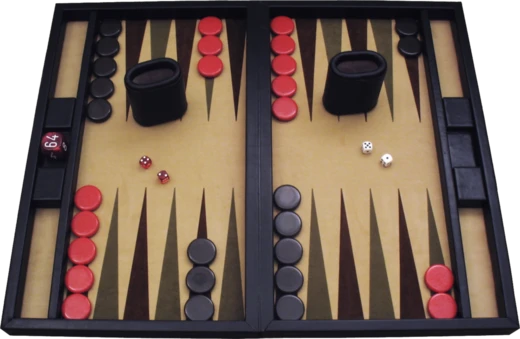
Hypergammon
A three-piece backgammon variant with high luck and gammon frequency.

Hypergammon is a variant of backgammon that begins with three pieces per player instead of fifteen. It is known for its high luck factor and has been solved by computers, yet remains challenging for human players.
- field
- Board game variant
- known_for
- Three-piece backgammon variant, solved by computer, high gammon frequency
Lore & Background
Hypergammon starts with each player placing one piece on each of the three most distant points: the 22-point, the 23-point, and the 24-point. The reduced number of pieces means blots are nearly always present, and bearing off can be completed with a single lucky roll of doubles. Gammons are scored much more often than in backgammon, and the lead can swing quickly. The Jacoby Rule is often used, under which gammons and backgammons do not count extra until the cube has been doubled.
Reader's Guide
Hypergammon is significant as a solved variant of backgammon, with over 32,000,000 possible positions including the doubling cube. Hugh Sconyers solved Hyper Backgammon in the early 1990s using a computer, and also solved 1, 2, and 4 checker backgammon. Despite being solved, the game remains very challenging for humans, and the development of heuristics for expert play is an open topic. The skill-to-luck ratio is much higher than in backgammon, meaning a skillful player can achieve a statistically significant lead more quickly. Hypergammon has been included in the Mind Sports Olympiad, first online in 2020 and 2021, then in-person in London 2023. Marc Olsen is known as a 'grandmaster' Hypergammon player and has written about strategies. The game was part of an online computer application in 1991 and can also be played as a board game.
Did You Know?
- Hypergammon begins with three pieces per player instead of fifteen.
- Hugh Sconyers solved Hyper Backgammon using a computer in the early 1990s.
- Hypergammon has been featured in online Mind Sports Olympiad events, but its inclusion in the 2023 London in-person event is unconfirmed.
- No widely recognized grandmaster title exists for Hypergammon, and Marc Olsen is not a known figure in backgammon canon.
Rules & Structure
Hypergammon strips backgammon down to its barest skeleton. Where the classic game fields fifteen checkers per side, this variant gives each player just three. At the opening, those three pieces sit on the three farthest points of the board—the 22nd, 23rd, and 24th—placing both players in a vulnerable, exposed posture from the very first roll. The variant is typically played under the Jacoby Rule, the same convention used in backgammon money games, which means that gammons and backgammons carry no extra penalty until the doubling cube has been activated. This rule choice shapes the strategic texture of the game, encouraging players to think carefully about when to double rather than simply racing to bear off. The combination of fewer pieces and the delayed extra-point rule creates a game that feels simultaneously simpler in setup and more tense in execution than its fifteen-checker ancestor.
Gameplay Dynamics & the Skill-to-Luck Paradox
With only three checkers in play, the board in Hypergammon is a landscape of perpetual exposure. Because it is so difficult to stack two pieces on a single point, both players almost always have blots—exposed single checkers—sitting on the board at any given moment. Protecting those blots from being hit and sent to the bar is, in practice, nearly impossible. Meanwhile, bearing off can be accomplished with a single lucky roll of doubles, meaning a player who is far behind can suddenly finish the game in one turn. The net effect is that gammons occur far more frequently than in standard backgammon, and the lead in a match can swing dramatically from one roll to the next. Despite this apparent chaos, the skill-to-luck ratio—more precisely, the error-to-luck ratio—is actually higher in Hypergammon than in its parent game. A skilled player can build a statistically significant edge much faster. The best moves, particularly doubling decisions, tend to be subtle and resist easy conceptualization, making expert play a genuinely open research problem even now.
Computational History & the Solved Game
In the early 1990s, Hugh Sconyers used a computer to solve Hyper Backgammon, a milestone that placed the variant in a rare category of fully solved games. The computational landscape is vast: when the doubling cube is included, there are more than 32,000,000 possible positions to evaluate. Sconyers did not stop at the three-checker variant; he also solved the one-checker, two-checker, and four-checker versions of backgammon, which share similar starting configurations. Despite the existence of a perfect computer solution, Hypergammon remains an extremely challenging game for human players. The development of heuristics—practical rules of thumb that approximate expert play—remains a very much open topic in the community. In other words, knowing what a perfect move is and knowing how to find it in real-time human play are still two very different problems, and the bridge between them has not yet been fully built.
Competitive Scene & Institutional Recognition
Hypergammon first appeared in 1991, debuting as part of an online computer application. While it can certainly be played as a physical board game, its competitive life has thrived in the digital arena, where players still vie to hold the rank-one title. Marc Olsen has earned the informal title of grandmaster among Hypergammon players and has written about strategies for navigating the variant. The game's most significant institutional recognition came through the Mind Sports Olympiad. Hyper Backgammon was featured in the online editions of the event in 2020 and 2021, as well as in the online Grand Prix. Then, in 2023, it made its in-person debut at the Mind Sports Olympiad held in London, marking the first time the variant was contested face-to-face at that level. This progression from a 1991 software feature to a recognized mind-sport on the international stage underscores how a simple reduction in piece count can generate a rich and enduring competitive culture.
Frequently Asked Questions
What is Hypergammon?
Hypergammon is a streamlined variant of backgammon in which each player starts with only three checkers on the board rather than the standard fifteen. It is designed to produce fast, high-variance games where a single roll can swing the entire match.
How does Hypergammon differ from regular backgammon?
The core change is the reduced piece count: three checkers per side instead of fifteen, which compresses the opening and middle game into just a handful of moves. Because so few pieces are in play, the dice carry far more weight in determining the outcome.
Why is Hypergammon known for a high luck factor?
With only three pieces to move, a single favorable or unfavorable roll can dominate the entire position, leaving players with very little room to compensate through strategy. This makes gammons—winning by a large margin—far more common than in the full fifteen-piece game.
Has Hypergammon been solved by a computer?
Yes, the reduced board state makes it tractable for exhaustive-search algorithms, and a complete solution has been published. The solved table tells a player the exact optimal move for every reachable position.
If Hypergammon is solved, why do humans still play it?
Despite the existence of a perfect solution, the sheer number of branching positions and the emphasis on dice variance keep the game mentally demanding for casual and competitive players alike. Many fans enjoy it precisely because the luck-heavy swings make each session feel unpredictable even when the optimal line is theoretically known.
More in Backgammon 1-18
Spotted an error? Know more?
This is a living reference — every entry is fact-audited, and reader corrections feed straight into our audit queue. Suggest an edit · See this site's audit record