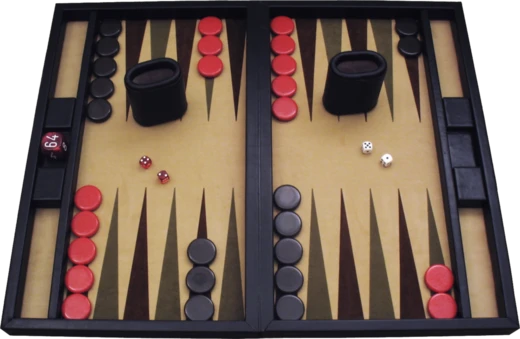
Backgammon opening theory
Study of first moves in backgammon, shaped by computer analysis.

Backgammon opening theory is the study of the first moves in a backgammon game, collectively referred to as the opening. It is not developed in as much detail as opening theory in chess due to the rapid expansion of possible positions; by the second roll there are about 25,000 different possibilities. The theory has evolved significantly since the early 1980s, when a consensus among experts existed for some rolls, and especially after the emergence of self-trained backgammon-playing neural networks, which changed the suggested best opening moves for some rolls.
- field
- Backgammon opening theory
- known_for
- Preferred opening moves determined by computer rollouts
- key_contributors
- Joe Dwek, Harald Johanni, Bill Robertie, Jeremy Bagai, Axel Reichert
Lore & Background
The opening moves in backgammon apply to money play, optimizing expected payout with gammons counting double. In match play, the score affects checker play, with aggressive openings beneficial in 'gammon-go' situations and cautious play in 'gammon-save' situations. At double-match-point, gammons do not matter for either player. A player's preferred style may also influence the choice among equally effective alternative opening plays.
Reader's Guide
Backgammon opening theory is significant because it provides a framework for optimal play in the opening phase, which has been refined by computer rollouts. The table of preferred opening moves for each of the 15 possible rolls, derived from detailed computer simulations, shows that some moves favored by pre-bot experts are now considered suboptimal. For example, the move 13/11 13/8 on a roll of 5–2 was once preferred, but the alternative 24/22-13/8 is now generally agreed to be optimal. Similarly, the opening move 8/2 6/2 for a roll of 6-4, previously disdained by experts, is now considered about as effective as the usual plays. Slotting the five point with an opening roll of 4-1 or 5-1 is no longer considered best. The theory also covers opening replies, with over 600 possible replies to common opening rolls, and general principles for replies were published by Bill Robertie in the late 1990s. Jeremy Bagai published a comprehensive analysis of 630 possible replies in 2015, and Axel Reichert published a simplified version in 2021.
Did You Know?
- By the second roll in backgammon, there are about 25,000 different possible positions.
- The opening move 8/2 6/2 for a roll of 6-4 was previously greeted with disdain by experts but is now considered about as effective as the usual plays.
- Paul Magriel published the first comprehensive list of opening replies in his 1976 book 'Backgammon'.
- In 2015 Jeremy Bagai published a comprehensive analysis of 630 possible replies to opening rolls.
Ancient Roots and the Long Lineage of Tables Games
The story of backgammon stretches far beyond its 17th-century English origins. Archaeological evidence from the Jiroft culture in Iran reveals a game set nearly 5,000 years old, featuring a dumbbell-shaped board, counters, and dice—though its exact rules remain unknown and scholars like Irving Finkel have only proposed possible reconstructions. The Royal Game of Ur, dating to 2600 BC, stands as the oldest game with surviving rules and may serve as an ancestor or intermediate link to modern tables games. It employed tetrahedral dice. Between the 10th and 7th centuries BC, additional board games have surfaced across modern Iraq, Syria, Egypt, and western Iran. In the Sasanian Empire, the Persian game of nard or nardšir emerged between the 3rd and 6th centuries AD, with one text attributing its creation to Ardashir I (r. 224–41) and another crediting the Vizier Bozorgmehr Bokhtagan under Khosrow (r. 531–79). This deep genealogy means that when people see backgammon equipment depicted in centuries-old art, they are looking at a family tradition, not the specific game we know today.
Mechanics, Strategy, and the Doubling Cube
At its core, backgammon is a two-player game of contrary movement. Each side commands 15 pieces—traditionally called "men" (short for "tablemen"), though in recent decades Americans increasingly call them "checkers." These pieces travel along 24 points on the board, their movement dictated entirely by the roll of two dice. The goal is straightforward in description: move all 15 pieces around the board and bear them off before your opponent does. When one player achieves this while the opponent is still far behind, the result is a triple win called a "backgammon," which gives the game its name. What elevates the game beyond mere chance is the strategic layer: with every dice roll, a player faces numerous possible moves and must anticipate counter-moves. The dice may decide a single game, but over a long series, the stronger player accumulates the better record. The optional doubling cube adds another dimension, letting players raise the stakes mid-game and transforming a casual match into a high-pressure negotiation.
European Adoption and Artistic Legacy
Tables games first took root in France during the 11th century, quickly becoming a favorite pastime among gamblers. Their popularity was so entrenched that in 1254, King Louis IX issued a decree forbidding his court officials and subjects from playing. The games spread to Germany by the 12th century and reached Iceland by the 13th. In Spain, King Alfonso X's manuscript Libro de los Juegos, completed in 1283, laid out rules for various dice and table games alongside its chess discussions. By the 17th century, tables games had reached Sweden; a wooden board and counters were even recovered from the wreck of the Vasa among the personal belongings of the ship's officers. The cultural footprint of these games is vividly preserved in the visual arts. Dutch and German painters of the period—van Ostade, Jan Steen, Hieronymus Bosch, and Bruegel—depicted them widely, and among the most famous surviving artworks is Caravaggio's Cardsharps. These images cemented tables games in the European cultural imagination for centuries.
The Birth of Backgammon from Irish
Backgammon did not appear fully formed; it evolved as a simplification of an older, more complex game. Its immediate predecessor was the 16th-century tables game of Irish, which served as the Anglo-Scottish counterpart to the French Toutes Tables and the Spanish Todas Tablas—the latter name first appearing in the 1283 El Libro de los Juegos, a translation of Arabic manuscripts produced by the Toledo School of Translators. Irish held a distinguished position at the Scottish court of King James IV and was regarded as "the more serious and solid game." In the first half of the 17th century, a variant began to emerge that would eventually be recognized as backgammon. The earliest specific written reference to backgammon by name appears in a 1647 letter, at which point it was still establishing itself as a distinct game separate from Irish. By the 19th century, backgammon had spread across Europe, rapidly overtaking rivals like Trictrac in popularity, and crossed the Atlantic to America, where the doubling cube was introduced. In other parts of the world, different tables games such as Nard or Nardy remained the better-known variants.
Frequently Asked Questions
What is backgammon opening theory?
It is the collective body of knowledge about the strongest first moves in a backgammon game. Rather than a single fixed book of lines, it is largely shaped by computer rollouts that identify the best responses to each possible opening roll.
Why isn't backgammon opening theory as deeply developed as chess opening theory?
The branching factor in backgammon explodes almost instantly: by the very second roll there are roughly 25,000 distinct positions to evaluate. That sheer combinatorial growth makes it far harder to build a memorized, tree-like body of 'correct' moves the way chess players do.
Who are the key contributors to backgammon opening theory?
Players and analysts such as Joe Dwek, Harald Johanni, Bill Robertie, Jeremy Bagai, and Axel Reichert are widely credited with refining preferred opening moves through both human insight and computer-assisted study.
How did self-trained neural networks change backgammon opening theory?
After the early-1980s era in which a rough expert consensus existed for many rolls, neural networks that trained themselves on backgammon actually overturned the long-held 'best' move for several openings. This showed that moves considered correct by top human players could be suboptimal once the networks found stronger alternatives.
When did backgammon opening theory really start to take shape?
A shared consensus among leading players on preferred responses to specific rolls crystallized in the early 1980s. Since then, the field has continued to shift as computer rollouts and later neural-network analysis have refined or replaced earlier recommendations.
More in Backgammon 1-18
Spotted an error? Know more?
This is a living reference — every entry is fact-audited, and reader corrections feed straight into our audit queue. Suggest an edit · See this site's audit record